
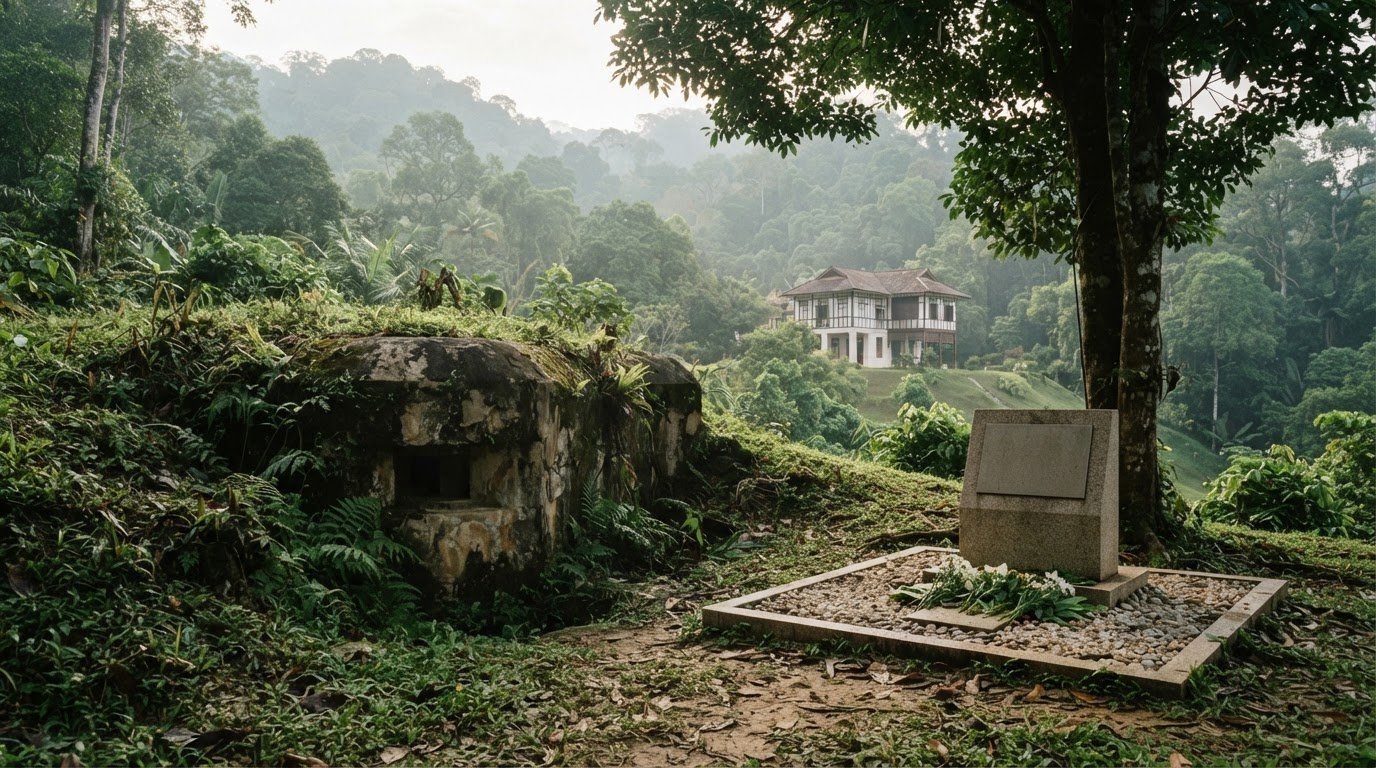
The most meaningful Malaysia military history tour follows the campaign across places, not a single battlefield. It can connect Changi and the Ford Factory with Penang’s wartime landmarks and sites linked to Australian actions across Malaya. These locations trace the fall of Malaya and Singapore, the occupation and the human cost of conflict.
Before choosing a journey, consider which places it visits, how they fit together and what their histories help us remember. A well-planned route puts each stop in context, from military decisions and resistance to the experiences of those who served and endured the occupation.
This guide explains the differences between Penang’s wartime history and Malaya campaign sites, and how Australian actions at Mersing, Gemas, Muar and Parit Sulong fit into the wider story. It also outlines what to look for in a commemorative tour, helping you choose an itinerary that suits your interests and approach these places with understanding and respect.
Key Takeaways
- Use the sites’ locations and historical connections to shape a route that follows the wider campaign.
- Understand how Penang’s occupation story is reflected in its wartime sites and memorials.
- Trace Australian actions across Malaya and see how individual locations connect to the campaign.
- Compare tour packages by their itinerary, historical focus and the time they allow at each site.
- Approach cemeteries, bunkers and other heritage landmarks with context for the events and people they commemorate.
Changi, the Ford Factory and wartime aftermath
Commemorative tours can follow the campaign through Malaya and continue to Singapore for Changi and the Former Ford Factory. Because Singapore is a separate country, a route covering both involves crossing the border. Together, these places help explain the fall of Singapore and the campaign’s wider consequences.
At Changi, focus on captivity and remembrance. The name is closely associated with prisoners of war during the Japanese occupation. Visiting the site brings a personal dimension to the campaign, beyond military movements and decisions. Consider who was held there, how captivity shaped their lives, and how commemoration preserves their stories. Its significance becomes clearer alongside the events that led to Singapore’s fall.
The Former Ford Factory offers a different perspective. The building is associated with the surrender that ended the British defence of Singapore. Its wartime significance connects political and military decisions with the lives affected by occupation. Read the exhibits in sequence, then consider how the events presented there relate to the campaign’s earlier movements through Malaya. This helps connect Kuala Lumpur, the peninsula and Singapore, rather than treating each stop as an isolated landmark.
Plan the route around that historical sequence. Begin with Malaysian campaign locations, including Kuala Lumpur, then cross into Singapore to visit Changi and the Ford Factory. Allow space in the itinerary to absorb each site’s distinct purpose. Changi speaks to imprisonment and remembrance; the Ford Factory centres on surrender and the turning point in Singapore’s defence. Their different stories deepen understanding of the same campaign.
The aftermath also extends beyond Singapore. More than 800 Commonwealth soldiers and troops are buried at a site connected to the Malaya campaign. A cemetery visit brings the human cost into view and gives the wider military history a place for quiet reflection. Read the names and service details respectfully, and consider how the graves connect individual loss with the campaign’s broader story.
These sites suit travellers seeking a connected account rather than a collection of unrelated stops. Before choosing an itinerary with Historic War Tours, identify whether it covers Malaysian campaign sites, Singapore landmarks or both. Consider how the sequence explains the advance, surrender and aftermath. A considered route connects the forces involved with the people who endured the conflict, while giving Changi, the Former Ford Factory and burial sites distinct places in the story.
Travellers exploring a Malaysia military history tour can easily connect the southward movement through Malaya with the events in Singapore and their aftermath. The Royal Malaysian Air Force was created after Parliament passed the Air Force Ordinance on 2 June 1958. That later development can help visitors place the wartime story within a longer account of Malaysia’s military history, without confusing it with the events at Changi or the Ford Factory. Keep the distinction clear: the campaign’s sites explain occupation, surrender and loss, while this fact marks a later institutional milestone. It can serve as a closing point for reflection after the route has followed the campaign from the peninsula into Singapore.
Penang's Japanese occupation during World War II
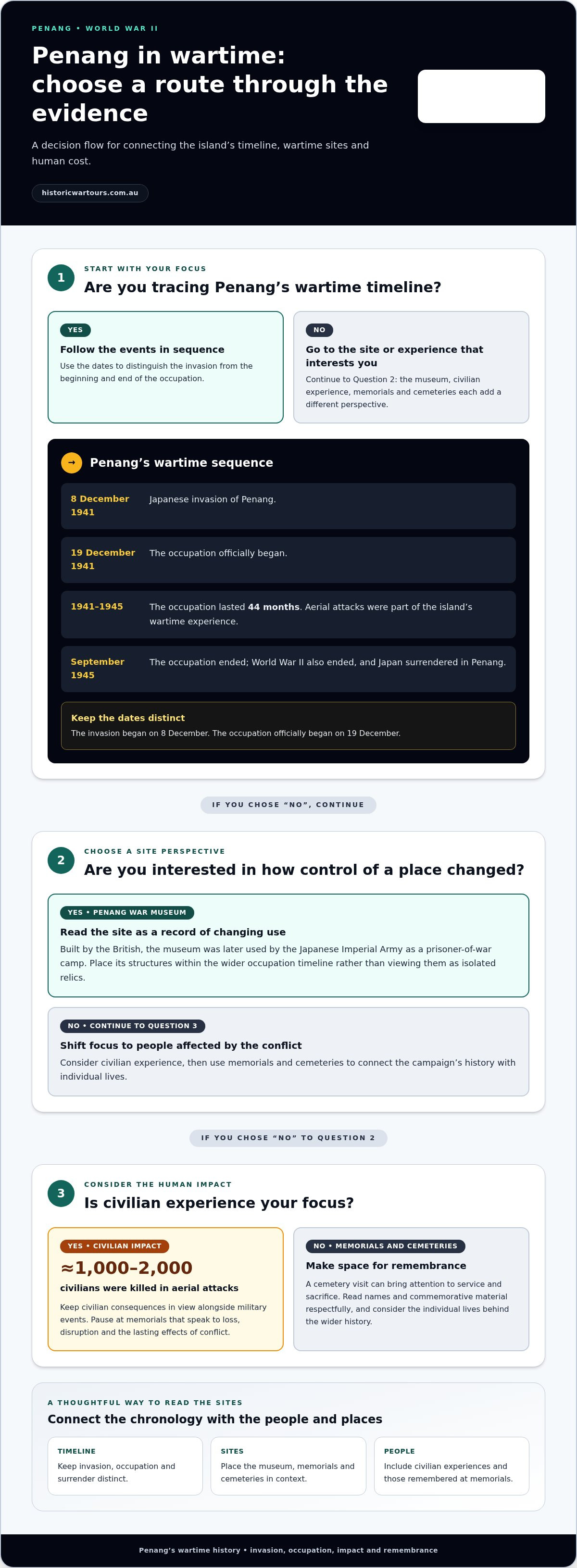
Penang’s wartime story begins with the Japanese invasion on 8 December 1941. The occupation officially began on 19 December 1941 and lasted 44 months, from 1941 to 1945. Keeping these dates distinct helps visitors understand the difference between the invasion and the start of occupation. A well-planned visit can follow this timeline through the island’s landmarks, memorials and wartime sites.
Penang’s wartime history includes the effects of aerial attacks. The raids killed approximately 1,000 to 2,000 civilians, a grave reminder that wartime operations carried consequences far beyond military forces. This history adds essential context to the island’s occupation story. Consider civilian experience alongside military events, and pause at memorials that speak to loss, disruption and the enduring effects of conflict.
The Penang War Museum offers a physical connection to the island’s changing military history. Built by the British, the site was later used by the Japanese Imperial Army as a prisoner-of-war camp. These successive uses show how control changed during the conflict. As you explore, place the museum’s wartime role within the wider occupation timeline rather than viewing its structures as isolated relics.
For a thoughtful visit, establish the sequence first: invasion, occupation, Allied bombing and surrender. Then consider how each location or exhibit fits that chronology. The Japanese occupation ended in September 1945, when World War II also ended and Japan surrendered in Penang. This final date helps bring the island’s wartime account into focus, while leaving room to reflect on the lives shaped by those years.
Penang’s history is part of the wider story of the Commonwealth and the campaign across Malaya. Visiting a cemetery can bring attention to the service and sacrifice associated with the conflict. Give memorials time and approach them respectfully. Their names and commemorative purpose connect military history with individual lives, including those who served far from home.
Choose sites that illuminate different parts of the timeline. The Penang War Museum shows how a British-built location was used during the occupation, while memorials and cemeteries offer space to remember those affected. Read interpretive material with the dates in mind, and notice how civilian experiences appear alongside military events. This creates a clearer, more human account of Penang’s wartime past.
For a wider journey that places Penang among Malaysia’s wartime landmarks, explore Malaysia’s military history. Connecting island sites with the broader campaign can help visitors understand how occupation, resistance and remembrance intersect across the region.
Before entering the Penang War Museum, one visitor review recommends familiarising yourself with the history: its explanatory signs are poorly written and sporadic. The wider campaign also involved volunteer and air forces. During World War II, the Straits Settlement Volunteer Reserve Force expanded to 1450 men, while the Malayan Volunteers Air Force was established in 1940 and continued until 1942 during the Fall of Malaya.
Wartime bunkers and heritage landmarks
Malaysia’s wartime landscape includes memorials, military museums and older defensive landmarks. Distinguish sites directly connected with World War II from places that provide broader historical context.
Military site safety and access
Access and photography rules depend on the individual site, especially where a location remains in military use. Follow posted signs and staff directions, stay within visitor areas, and photograph only where permitted. At heritage sites, respect barriers and preserve the dignity of memorial spaces. These steps help visitors move through each location safely and respectfully.
Before setting out, consider the demands of each stop. The Penang War Museum merits 2-3 hours, while Fort Cornwallis merits 1.5-2 hours. These suggested visit lengths help shape a practical day, but site layout and the depth of your visit affect how much you can see. Allow time to read exhibits and pause at memorials, rather than treating each place as a quick photograph stop.
World War II and occupation sites
For World War II and Japanese occupation history, visit the Penang War Museum. The British built it, and the Japanese Imperial Army later used it as a prisoner-of-war camp. The Commonwealth War Cemetery in Penang contains 828 graves of World War II soldiers. Together, these sites bring military history and remembrance into focus.
Other landmarks add different layers. Muzium Tentera Darat offers military history, while the Taiping war memorial honours those who served. Fort Cornwallis in Penang dates to 1772, so it provides an older heritage context rather than a direct account of World War II. Separating these roles helps you choose stops that match the history you want to understand.
Build your route around each site’s purpose. Pair the Penang War Museum with the Commonwealth War Cemetery to consider occupation, captivity and remembrance. Include Fort Cornwallis for context on Penang’s earlier defences, not as a substitute for a wartime site. In Taiping, the war memorial offers a place to reflect on service and sacrifice.
During a tour of campaign sites, Rifle Company Butterworth visitors researched and cleaned gravestones at the Taiping memorial. The example shows how visits can include acts of care alongside historical interpretation. A visitor to Muzium Tentera Darat reported an underground area used by communists, adding another layer to the site’s military associations. Consider each landmark in its historical context, and give commemorative spaces the attention they deserve.
For a considered itinerary, group nearby landmarks and leave time to read and reflect. The Penang War Museum, cemetery and Fort Cornwallis each serve a different purpose. Choosing deliberately helps you trace World War II and occupation history without confusing it with Malaysia’s broader military heritage.
Australian actions at Mersing, Gemas, Muar and Parit Sulong
Australian Imperial Forces achieved early successes during the Malaya campaign but could not repel the Japanese advance. Mersing, Gemas, Muar and Parit Sulong help trace this contested campaign across the peninsula.
Australian actions at Gemas
At Gemas, consider Australian actions within the wider account of the advance through Malaya. A campaign itinerary also includes nearby Gemencheh, helping visitors distinguish the two names and understand their place in the route. Look for interpretation connecting these locations with the Australian Imperial Forces’ early successes and their eventual inability to stop the advance.
Rifle Company Butterworth’s tour of important campaign sites included Gemencheh, Parit Sulong and Muar, as well as Jitra, Gerik and Kampar. Following a route like this shows how individual stops contribute to the wider campaign story. At Gemas, focus on its place in the route and the Australian presence, rather than assuming every stop tells the same part of the story.
Australian actions at Muar
Muar offers a point from which to consider how the campaign changed direction. The Rifle Company Butterworth tour ended there after visiting Parit Sulong and other sites across Malaysia. This sequence places Muar within a wider journey and gives visitors space to reflect on the advance’s impact on Australian forces across the peninsula.
Compare Muar with Gemas and Mersing. Consider how the route links these sites and what each contributes to understanding Australian actions. A considered itinerary leaves room for these questions instead of treating place names as a checklist. The contrast between early successes and the inability to repel the advance remains central.
Australian actions at Parit Sulong
Parit Sulong is another stop on the Rifle Company Butterworth route. Its place before the journey’s end at Muar establishes a geographical sequence for visitors. Read the site’s interpretation alongside the wider account of Australian Imperial Forces in Malaya, distinguishing documented campaign context from each location’s specific story.
The 130th rotation of Rifle Company Butterworth conducted a six-day tour of important Malaya campaign sites in Malaysia in September 2020. Its route included Jitra, Gerik, Kampar, Gemencheh and Parit Sulong, ending at Muar. That example shows how a multi-site journey can connect locations across the campaign without reducing them to isolated names.
Mersing belongs on a route covering Australian actions across Malaya, alongside Gemas, Muar and Parit Sulong. Use the place names to follow the campaign’s geography, then consider the wider outcome: Australian forces achieved early successes but could not repel the Japanese advance. The Rifle Company Butterworth route offers one model for connecting sites, although its listed stops do not include every place named in this section. At each stop, look for context explaining its connection to Australian actions and take time to reflect on the campaign’s human consequences.
Malaysia military history tour packages
Tour packages differ in historical focus, route and time available. Compare the sites on the itinerary and the context provided for each stop.
Tour package options
A commemorative tour can focus on the Malaya campaign and fall of Singapore, or connect several wartime regions. One example, scheduled for 18-27 September 2025, was a 10-day fully escorted battlefield tour. Rifle Company Butterworth’s tour of campaign sites lasted six days in September 2020. These examples show how route and purpose shape duration.
Compare packages by the places visited, the historical narrative and the time allowed at each site. A route through campaign locations serves a different purpose from a visit focused on museums and memorials. Check whether the itinerary connects events in sequence rather than presenting every landmark as a separate stop.
Military history sites in Sabah and Sarawak
In Sabah, Sandakan Memorial Park commemorates prisoners of war who died during the Sandakan Death Marches. In Sarawak, Batu Lintang Camp was a Japanese prisoner-of-war and civilian internment camp, and its memorial site reflects that history. These places add Borneo’s wartime experiences to a journey focused on the peninsula.
Consider how each site broadens the itinerary. Sandakan relates to captivity and the death marches, while Batu Lintang focuses on internment. Their histories differ from campaign landmarks such as Gemas and Muar. Together, they show that Malaysia’s wartime heritage extends beyond a single region or military story.
Tour duration
Tour length depends on the route and how many sites it connects. Examples include the six-day Rifle Company Butterworth tour in September 2020 and the 10-day fully escorted tour scheduled for 18-27 September 2025. These are specific itineraries, not a standard duration for every journey.
Let the route guide your choice. A journey spanning several regions needs time for travel between locations, while a focused itinerary can concentrate on fewer sites. Compare the number and spread of stops with the historical detail you want from the visit.
Travel between military history sites
Malaysia’s campaign sites are spread across different locations, so travel arrangements shape the itinerary. The Rifle Company Butterworth route connected Jitra, Gerik, Kampar, Gemencheh and Parit Sulong before ending at Muar. Follow the sequence to understand the route’s geographical reach.
If you are combining Penang, Malaya campaign sites and Sabah or Sarawak, consider the distances between regions when choosing a package. The itinerary shows which places are connected and in what order, making it easier to judge whether there is enough time at each site.
For Penang War Museum, listed daily opening hours are 9:00 am to 5:00 pm. Penang War Cemetery is free to visit from dawn to dusk. Admission and booking arrangements vary by museum, so there is no single ticket price or booking rule for all Malaysian military museums.
Historic War Tours: Anzac Day Tours
Historic War Tours offers fully escorted Malaysia tours for travellers interested in military history and commemorative landmarks. Its Anzac Day Tours offer another way to engage with Australia’s remembrance traditions. Choose according to the history you want to explore: Malaysian campaign sites, Anzac commemoration or both as part of a wider travel plan.
Turn to Historic War Tours when you’re ready to shape a journey around the places and stories that matter to you. The route’s historical focus can guide which locations deserve your time and attention. For a considered next step, visit Historic War Tours.
Carry remembrance into your next journey
Visiting wartime sites can deepen your understanding of the choices, losses and service behind their history. Let that guide your next step: consider what you want to learn, whose experiences you want to honour and how a Malaysia military history tour can bring those priorities into focus.
Historic War Tours offers Malaysia tours, Anzac Day Tours and Burma Thailand Tours for travellers drawn to remembrance and military history. Choose the journey that reflects the stories you want to explore, then prepare to honour the people and places it commemorates.
Contact Historic War Tours to take the next step towards a thoughtful journey. Let remembrance guide the way.
Frequently Asked Questions
What are the best military history tours in Malaysia?
Choose a fully escorted Malaysia tour that matches the history you want to explore. A Malaysia military history tour can cover historic battlefields, defensive lines and memorials, with experienced English-speaking guides providing context. Consider how the itinerary connects its sites and whether its pace suits your interests. Hotel pick-up and drop-off, along with comfortable, air-conditioned transport, support travel between locations.
How much do Malaysia military history tours cost, and what is included?
The price depends on the itinerary, travel arrangements and accommodation, and is given after a quote request. Historic War Tours’ escorted Malaysia tours include experienced English-speaking guides, comfortable air-conditioned transport, hotel pick-up and drop-off, and good-quality 3 Star and 4 Star hotels. Review the proposed itinerary to understand its historical focus and included arrangements, then request a quote for the journey you have in mind.